
Precision Over Prompts
Most "AI video" is a mood board that looks different every time you run it. Production previs has to be the opposite: a visual contract, accurate enough to shoot against and consistent enough to trust. Here's how we make generative previs behave like a contract.
A director doesn't need another beautiful, unrepeatable image. They need to know where the camera goes, how the scene cuts, and what the day on set will actually deliver. The moment generative tools are used for previsualization, the brief flips from "make something striking" to "make something true" — true to the lens, true to the character, true to the geography of the set.
That's the whole discipline: precision, not hallucination. Previs is a decision-making tool backed by math, not an abstract concept reel.
What it is — and isn't
- It is a production-accurate visual contract: a decision tool for direction, pacing, and continuity that maps onto a real shoot.
- It is not a stylized concept animation, a final VFX render, or a vibe. Everything in frame is designed to translate directly to live-action or final VFX.
The difference shows up the second you try to use the previs on set. A mood board collapses; a contract holds.
The "Global Lock": one optical truth
Before a single shot is generated, we lock the optics for the whole sequence — the camera body it's emulating, the lens family, the aspect ratio, and the artifacts that lens would actually produce. Every shot then inherits the same optical fingerprint, so the previs cuts together like it came from one camera and a real DP can match it.
Identity permanence
The fastest way to expose AI previs as a toy is a character whose face, age, build, or wardrobe drifts between shots. So identity is a hard constraint, not a hope: zero variance in age, facial structure, or proportions, wardrobe locked to specifics, and a defined performance arc (still → aware → determined → momentum) that the sequence has to honor. Identity drift, skin-tone shifts, or wardrobe morphing are rejection triggers — the shot is regenerated, not "fixed in the edit."
Architectural rigidity
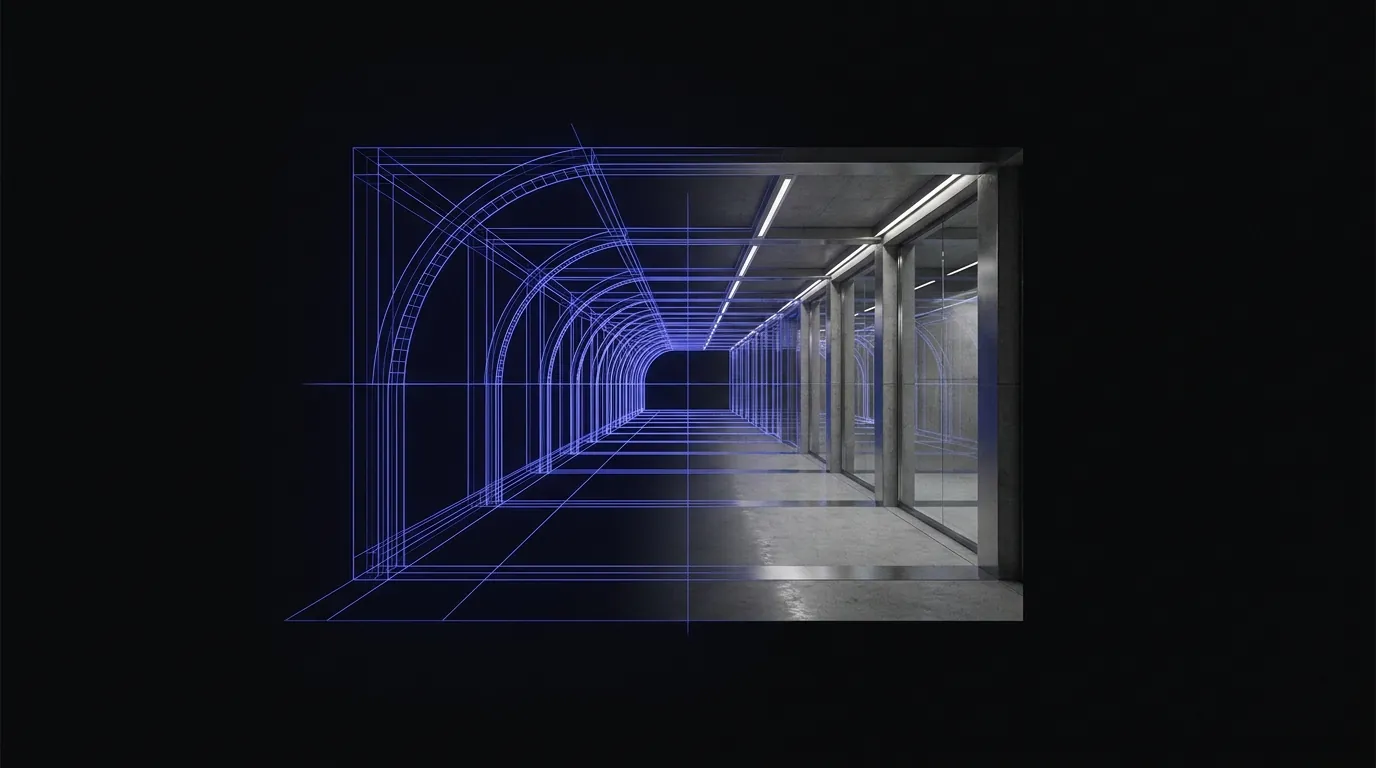
Environments get the same treatment. If the script lives in a concrete tunnel with a repeating structural rhythm, then the vanishing point, the scale, and the spacing of the lights have to stay consistent shot-to-shot, and lighting stays motivated by sources that exist in the space. Any shift in perspective geometry or light spacing is an immediate fail — because a set you can't navigate is a set you can't shoot.
Everything is designed to translate directly to live-action or final VFX.
Key takeaways
- Previs is a contract, not a concept reel — measure it by how well it maps to a real shoot.
- Lock the optics once (camera, lens, aspect, artifacts) so the whole sequence cuts as one camera.
- Treat character identity as a hard constraint; drift triggers regeneration, not editing.
- Keep environment geometry and motivated lighting rigid shot-to-shot.
Previs your next sequence
We build generative previs your DP, gaffer, and VFX sup can actually shoot against. Bring a scene — we'll show you what a production-accurate contract looks like.
Book a Call ↗