
Architectural Visualization vs. Cinematic AI Film: Why Static Renders Aren't Enough Anymore
Most of Toronto's architectural visualization market sells the same thing: renders. Clean, accurate, and everywhere. That's not a craft problem — it's a supply problem, and it leaves a real gap for anyone selling a building rather than documenting one.
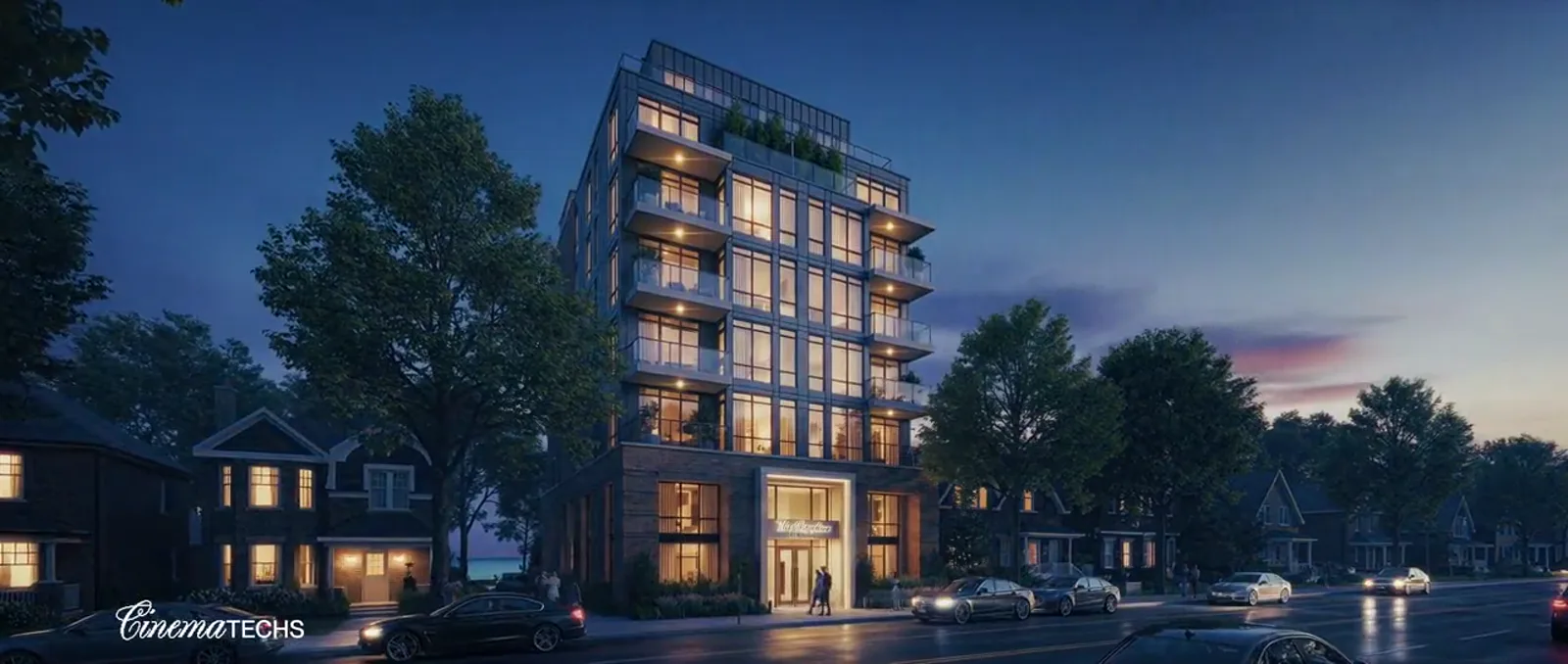
Search "architectural visualization Toronto" and you'll find a deep bench of studios doing genuinely good work. Look closer and you'll notice they're mostly selling the same product: 3D renders. A set of exterior stills, some interiors, maybe a turntable or a plain walkthrough. It's competent, it's photoreal, and it's nearly interchangeable from one studio to the next.
I don't say that as a knock. Renders are the right tool for a lot of jobs. But when the whole market defaults to the same deliverable, "photoreal" stops being a differentiator — everyone is photoreal now, and something more basic gets missed. A render tells you what a building will look like. It can't tell you what it will feel like to live there. For a planning submission, that's fine. For selling a home, it's the entire ballgame.
What a render studio delivers — and where it stops
A typical archviz package is a spec sheet in pictures. Accurate geometry, correct materials, a flattering camera angle, good light. You can hang it on a hoarding or drop it in a brochure and it does its job: it documents the design. A basic walkthrough extends that to motion, but it's usually a camera drifting through empty rooms — informative, not persuasive.
Where it stops is feeling. There's no time of day that means anything, no cut, no sense of a life being lived in the space. It answers the architect's question ("is this accurate?") rather than the buyer's ("can I see myself here?"). Those are different questions, and they need different tools.
What film-first actually means
We come at architecture from the other side. Before we model a single frame we ask the questions a director asks: who lives here, what does an evening feel like, where does the eye go, what's the one shot people remember. Then the building gets composition, a light story that moves from morning to dusk, a sequence, and a grade — the same disciplines behind a commercial or a piece of broadcast, pointed at a development.
The result isn't a nicer render. It's a different category of thing: a short film in which the building is the character. That's the gap the Toronto market leaves wide open, because doing it well requires filmmakers, not just a render pipeline. More on the studio and the credits behind it →
The AI-accelerated pipeline, applied to architecture
Here's the part that used to make film-for-architecture impractical: cost and time. A full cinematic treatment meant a render farm grinding out a day-cycle of looks, or a physical shoot you can't run on a building that doesn't exist. That's where our pipeline changes the math.
We run the same ethical, human-led AI process we use across the studio — a consent-gated pipeline built on client-authorized data, with every deliverable validated against signal and physics rather than judged on a single monitor, and finished into a managed master. Applied to architecture, that means we can generate a coherent day of light across one building, produce blue-hour aerials without a permit or a helicopter, and iterate in hours where a render queue took days. Fast, but held to a standard a broadcaster would accept. See the pipeline → · the AI aerials →
Proof: The Shoreline
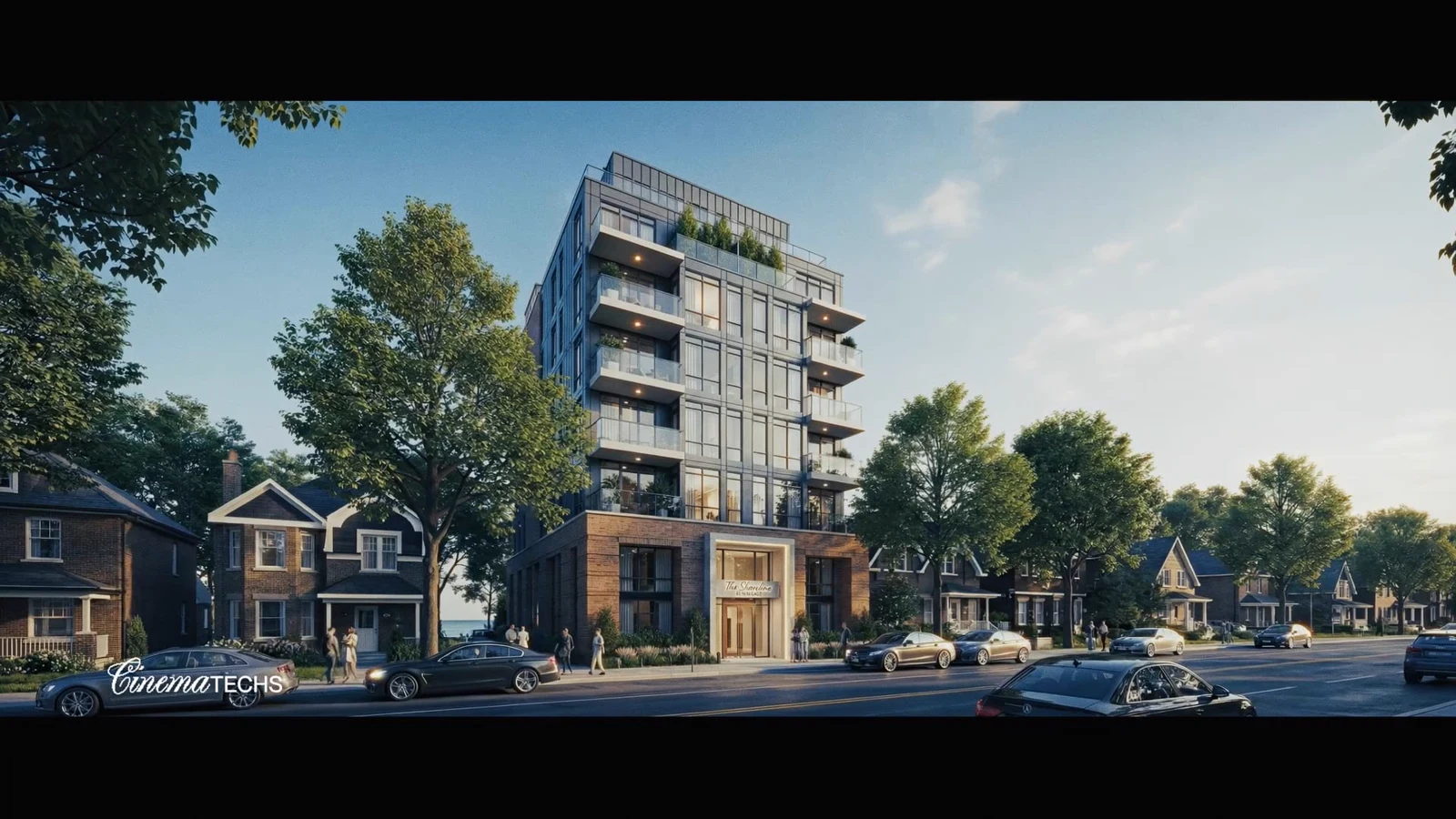
The clearest example is The Shoreline, a boutique lakeside mid-rise we launched in 2025. The brief was the classic pre-construction problem — sell a building that didn't exist yet, at a quality bar that reads as photography on a sales-gallery wall. We treated the development like a film: one location, many times of day, a single consistent light story from daybreak to blue hour, cut into a launch film and a matched set of stills. It carried the building from reveal to sell-out.
Notice what that is and isn't. It isn't a prettier render — it's direction, look-development, and grade applied to a piece of architecture, with the AI pipeline doing the heavy lifting on the looks. See the full case study →
When renders are genuinely enough
I'd rather be straight than oversell. If your job is documentation — a planning package, a permit set, a quick portal image, a spec brochure — you don't need a film, and paying for one would be waste. Plenty of projects only ever need clean, accurate renders, and a good render studio will serve you well.
The moment to reach for film is when you're selling: a pre-construction launch, a flagship building, a competitive site where the buyer's decision is emotional and the deposit is real. That's when the difference between "here's what it looks like" and "here's what your evening looks like" shows up in the sell-through.
Deciding whether your project needs renders or a film? Send us the drawings and the launch date — we'll tell you straight which one the project actually needs, and scope it within one business day.
Book a call ↗ See the workFAQ
What's the difference between architectural visualization and 3D rendering?
3D rendering produces still images or a basic walkthrough of a design — accurate, useful, and the right tool for permits, brochures, and portals. Architectural visualization done as film adds what rendering leaves out: composition, a lighting and time-of-day story, motion, sound, and a cut. One shows what a building will look like; the other shows what it will feel like to be there.
Do I need an architectural film, or are renders enough?
Renders are enough when the job is documentation — a planning submission, a spec sheet, a quick listing image. You want a film when you're selling: a pre-construction launch, a flagship development, anything where a buyer commits to a place they can't yet walk through. Most launches use both, with the film carrying the emotional case.
How much does architectural animation cost in Toronto?
Unlike per-image rendering (roughly CA$900–$2,500 for a development-grade exterior), a film or animation is scoped as a production against the launch and the number of looks required. An AI-accelerated pipeline changes the economics by producing a full day-cycle of looks without a physical shoot, so cost tracks scope and craft rather than render-farm hours.
How do I brief an architectural visualization studio?
Share the architectural files and materials, the launch date, the emotional positioning of the building (who lives here, what the evening feels like), the required deliverables and formats, and any brand or rights constraints. The more you say about feeling and audience — not just geometry — the more the result sells rather than just documents.